Insurance ads love to promise you’ll save a certain percentage by switching. A lower price is nice, but when policies compete on price, coverage can get trimmed to get there. One piece homeowners hear the least about is code upgrade coverage.
Most people never think about it until a storm damages their roof. Then they learn the new roof has to meet today’s building code, not the code from when their house was built, and that the extra cost may not be covered the way they assumed.
We’re a family-owned roofing and siding company in Roscoe and Rockford, and we’ve helped thousands of Rockford-area homeowners through roof claims since 2006. In our roof questions to ask your agent at renewal, we gave code upgrade coverage a short mention. This post goes deeper. It isn’t insurance or legal advice. Every policy is different, so check your policy and ask your agent.
What Is Code Upgrade Coverage?
Code upgrade coverage usually appears in a policy as ordinance or law coverage. It helps pay the extra cost of bringing a damaged home up to current building codes when it’s repaired or rebuilt after a covered loss.
Here’s why it matters. Your dwelling coverage pays to repair or replace what was damaged. On the standard homeowners form, that replacement cost doesn’t include the extra cost of meeting current code, except through the separate ordinance or law coverage. So if code requires your new roof to have something your old roof didn’t, that difference usually comes from ordinance or law coverage, up to its limit.
On a common homeowners form, ordinance or law coverage can help pay for three things:
- The extra cost to repair or replace the damaged part of the home to current code.
- Tearing down and rebuilding undamaged parts when code requires it to complete the repair.
- Removing the debris from that work.
It generally doesn’t pay for a drop in your home’s value caused by a code requirement.
How Much Coverage Do Most Policies Include?
On the widely used standard homeowners forms (HO-2, HO-3, HO-5 and HO-6), ordinance or law coverage is built in at 10% of your Coverage A dwelling limit. On the sample HO-3 form, it’s listed as additional insurance, so it sits on top of your dwelling limit instead of coming out of it.
Here’s what that looks like in dollars. If your dwelling coverage is $250,000, 10% gives you up to $25,000 for code-related costs. That may be plenty for a roof. But if a bigger loss hits an older home, 10% can run out fast.
You can usually raise the limit with an endorsement. Standard options include 25%, 50%, 75% or 100% of Coverage A, though each insurer chooses what it offers. Some only offer a small bump. Not every insurer uses the standard forms, either, so your policy may set the limit differently, cap it at a dollar amount, or leave it out. The only way to know is to read your declarations page and the “Additional Coverages” section, or ask your agent.
Which Building Codes Apply Around Rockford?
Code depends on where your house sits, so here’s what the local building departments publish:
- City of Rockford: Rockford follows the 2021 International Code Council codes, including the 2021 International Residential Code, with local amendments. The city’s climate table for that code marks ice barrier underlayment as required. Rockford requires a building permit for all roofing work, and residential roofs get a final inspection.
- Winnebago County: The county building division lists the 2015 International Residential Code as its residential code. That applies to unincorporated areas and to towns that use the county for building permits. Roscoe, for example, sends building permits for structures over 200 square feet through the county.
- Other towns: Loves Park, Belvidere, South Beloit and the Wisconsin towns we serve set their own rules or use their county’s, and codes get updated over time.
That’s the whole reason this coverage exists. An older roof was likely built to an older code, and a replacement today has to meet the current one.
Roof Code Items That Can Come Up on a Replacement
These are the code items we see come up most often on Rockford-area roof replacements. Whether each one is paid under the main claim or under ordinance or law depends on your policy and the adjuster’s estimate.
A full tear-off down to the deck
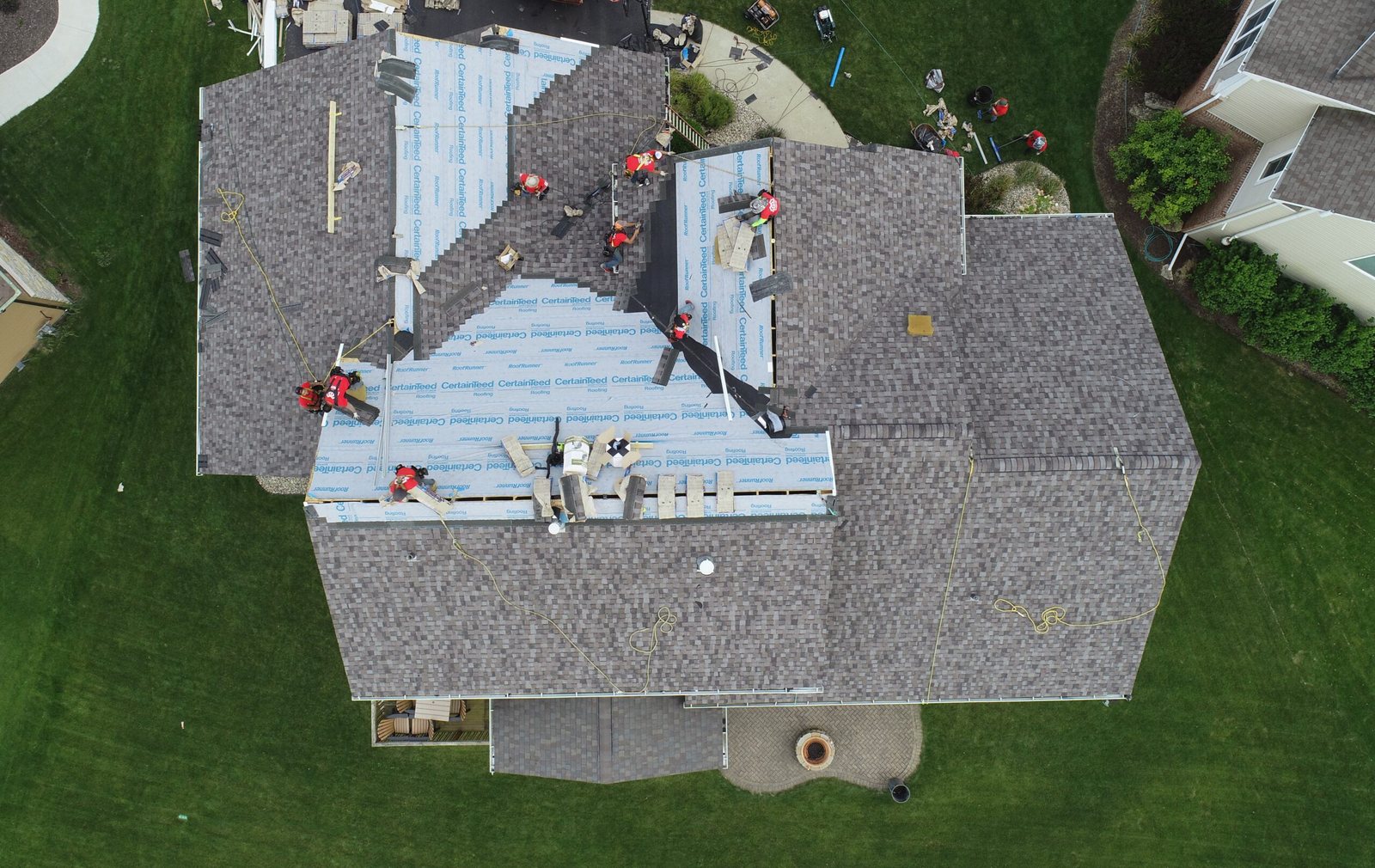
Under the 2021 code, a roof replacement means removing the existing roof coverings down to the deck. Adding a new layer over the old one (called a recover) isn’t allowed when the roof already has two or more layers, when it’s water-soaked or too worn to be a solid base, or when the existing roof is wood shake, slate or tile. If your house has two layers of shingles, everything comes off.
Solid roof decking
Many older homes around Rockford have plank board sheathing with gaps between the boards. The City of Rockford’s building department has put in writing that asphalt shingles must go on a solidly sheathed deck. On a re-roof, gaps of 1/3 inch or less count as solid, and the shingle maker’s instructions govern where they’re stricter. Wider gaps can mean new sheathing over the whole roof, and that’s a cost many homeowners don’t see coming.
Ice barrier at the eaves
Our winters bring ice dams. Code calls for an ice barrier where there’s a history of ice forming along the eaves and backing up water. The barrier runs from the edge of the roof to at least 24 inches inside the exterior wall line. Rockford’s building department has also explained when it requires one on a re-roof: when there’s evidence of ice damage, when an ice barrier was there before, or when the roofing manufacturer calls for it.
Many older roofs were never built with one. We put ice and water shield on every eave, so this is part of every roof we install. If ice dams are already causing leaks, see our ice dam leak repair page.
Drip edge at the eaves and rakes
Current code requires drip edge along the eaves and rake edges of shingle roofs, fastened to the deck, with the underlayment lapped over it at the eaves and under it at the rakes. Plenty of older roofs around here don’t have it.
Attic ventilation
Ventilation is driven by the shingle manufacturer as much as by code. GAF calls for balanced intake and exhaust ventilation, and its shingle warranty doesn’t cover problems caused by poor ventilation. If your attic needs more vents, ask how your policy treats that cost, since it may not count as a code item.
Why So Many Homeowners Find Out Too Late
Code upgrade coverage is easy to miss for a few reasons:
- It’s in the fine print. It’s usually listed under “Additional Coverages,” not on the front of the quote.
- It’s shown as a percentage, not dollars. “10%” doesn’t mean much until you multiply it by your dwelling limit.
- Price shopping skips it. When two quotes are compared only on the premium, nobody asks whose ordinance or law limit is higher.
- Older homes have more to catch up on. The older the house and roof, the more code changes have stacked up since they were built.
- Timing can matter. The standard form pays for the extra costs you actually incur, so ask your agent when this part of a claim gets paid.
None of this means your agent did anything wrong. It’s simply a question that’s easy to skip, so be the one who asks it.
Questions to Ask Your Agent
Bring your declarations page and ask:
- “Do I have ordinance or law coverage, and what’s the limit in dollars, not just a percentage?”
- “Is it on top of my dwelling limit, or does it come out of it?”
- “Does it cover the damaged part only, or undamaged parts too?”
- “Can I raise it to 25% or more, and what would that cost per year?”
- “Does my policy pay for code-required items like solid decking, ice barrier and drip edge on a roof replacement?”
- “Is ordinance or law paid when the claim is approved, or after the work is done?”
Comparing quotes? Ask each company the same questions. The cheapest premium may not be the cheapest policy once a claim comes in.
How We Can Help
Your agent knows your policy, and we know roofs and the local permit process. We help homeowners with storm claims and can work with your adjuster if needed. When code items are part of the job, we document them with photos and list them separately in our estimate so you and your adjuster can see what the current code requires. United Policyholders, a nonprofit consumer group, recommends breaking out code upgrade costs separately for just this reason. If an item gets missed, our page on roof insurance supplements explains how that works.
We’re a GAF Master Elite contractor, a status held by fewer than 2% of roofing contractors, and our GAF roofs come with up to 30 years on workmanship (GAF eligibility rules apply). Learn more about our storm and insurance claims help and roof replacement, including roof replacement in Rockford and roof replacement in Roscoe.
Know What’s Up There Before Winter
Fall is a good time to find out what your roof would need to meet code, before winter sets in. Martin Exteriors offers free roof inspections for everyone. We’ll check your roof and attic, take photos and tell you plainly whether things like decking, ice barrier or drip edge would need to be brought up to code. Then you can take those answers to your agent.
Call (815) 624-6278 or book your free roof inspection online.
Frequently Asked Questions
What is ordinance or law coverage on a homeowners policy?
It’s coverage that helps pay the extra cost of bringing a damaged home up to current building codes during repairs after a covered loss. It’s often called code upgrade coverage. Check your policy and ask your agent what yours includes.
How much ordinance or law coverage does a standard policy include?
Standard HO-3 homeowners forms include 10% of your dwelling (Coverage A) limit. Many insurers let you raise it with an endorsement, often to 25% or more. Not every insurer uses the standard forms, so check your declarations page.
What roof code items can come up on a roof replacement near Rockford?
Common ones include a full tear-off when there are already two layers, solid decking over old plank boards with wide gaps, an ice barrier at the eaves and drip edge at the eaves and rakes. Which items apply depends on your town’s code and your roof.
Does the City of Rockford require a permit for a roof replacement?
Yes. Rockford requires a building permit for all roofing work, and residential roofs get a final inspection. Roofing contractors must be licensed by the State of Illinois.
Can Martin Exteriors help with code items on an insurance claim?
We help homeowners with storm claims and can work with your adjuster if needed. We document code items with photos and list them in our estimate. We also offer free roof inspections for everyone. Call (815) 624-6278.
