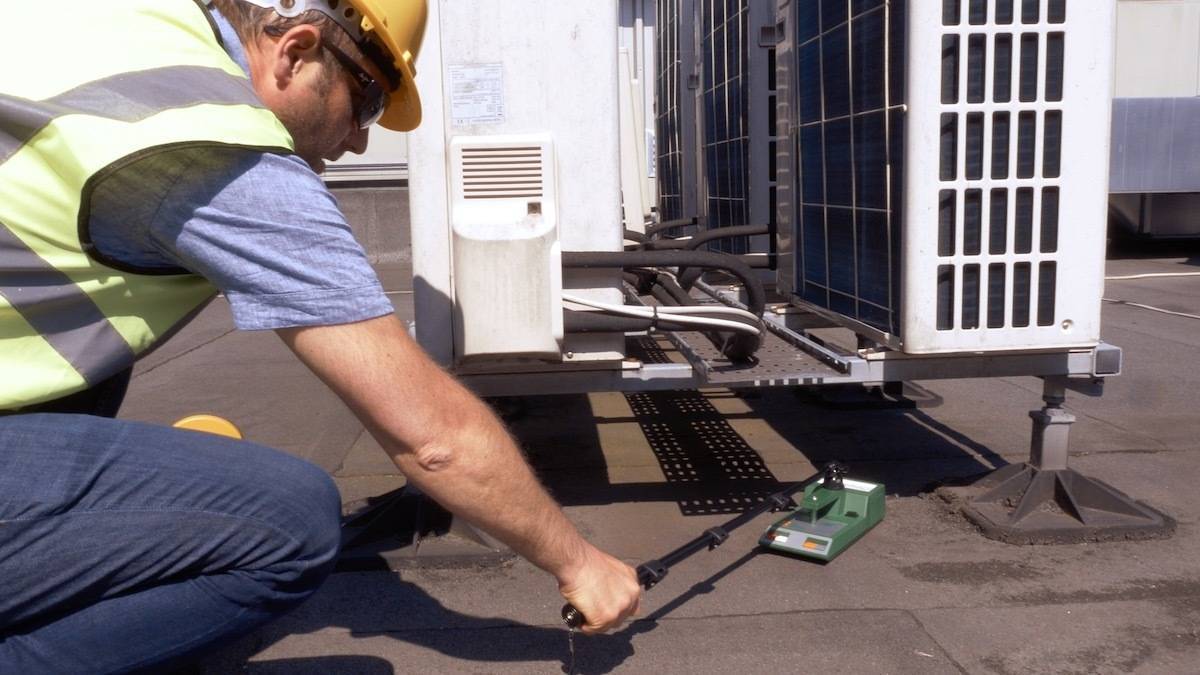
The Tramex RWS Roof and Wall Scanner, part of the Tramex Roofing Inspector Kit, in use on a flat roof. Photo: Tramex
If you own or manage a building with a flat or low-slope roof, you already know the frustrating part about leaks. The drip shows up over the break room, but the water got in somewhere else entirely. On a flat roof, water can slip through a tired seam or a loose flashing, run along the deck, and soak into the insulation for a long time before anyone sees a stain.
By the time a ceiling tile drops, the wet area under the membrane can be a lot bigger than the spot you see. That’s why we don’t just walk a commercial roof and guess. When we suspect trapped water, we use two tools built for the job: a Teledyne FLIR i64 thermal camera and a Tramex Roofing Inspector Kit moisture meter.
Here’s how a moisture survey works, what each tool does, and why it matters before winter sets in around Rockford.
Why water hides in a flat roof
Most of the buildings we work on have TPO, EPDM, PVC or modified bitumen roofs. Under that membrane is insulation board, and under that is the deck. When water gets past the membrane, the insulation soaks it up or it collects along the edges of the boards. The surface can look fine. Meanwhile the wet insulation stops insulating, adds weight, and keeps feeding leaks inside.
Our winters make it worse. Water trapped under the membrane goes through freeze and thaw cycles all season, and every cycle works on seams, flashings and the insulation itself. Finding wet areas in the fall gives you time to plan a repair instead of reacting to a leak in January.
Step one: the thermal camera
A thermal camera doesn’t see water. It sees temperature. Teledyne FLIR explains that wet insulation has a higher thermal capacity than dry insulation. After a sunny day, the whole roof warms up. Once the sun goes down on a clear evening, the roof starts to cool, and the wet areas hold their heat longer than the dry ones. Through the camera, those wet areas show up as warmer patches in the roof.
Our camera is the Teledyne FLIR i64. Its thermal sensor is 480 × 640, which is more than 300,000 temperature points in every image. That much finer detail makes small temperature differences across a big roof easier to spot and easier to show you. FLIR’s MSX feature also lays visible outlines from the camera’s regular 8 MP photo onto the thermal image, so you can tell exactly which drain, curb or seam you’re looking at.
A thermal image tells us where to look closer. It isn’t the final word. Repairs, different insulation and rooftop equipment can all show up as warm spots too. So step two is checking those spots.
Step two: the Tramex moisture meter
Our moisture meter is the Tramex Roofing Inspector Kit. The main tool in the kit is the Tramex RWS Roof and Wall Scanner, the green unit on the extension handle in the photo at the top of this post. According to Tramex, the RWS is a non-invasive impedance scanner that checks moisture in roofing systems down to about 4 inches, without cutting into the roof. Tramex says it’s designed for moisture evaluation and leak tracing in roofing per ASTM D7954.
The kit also has a few other tools Tramex packs with it:
- A CMEX5 digital moisture meter that reads moisture in concrete decks and, with its pin electrode, in wood decks and roofing materials
- A relative humidity probe and an infrared thermometer for surface temperature and dew point conditions
- An app that can GeoTag readings and build photos, reports and charts
Put the two tools together and we get a map: the thermal camera shows where the roof is acting differently, and the Tramex readings confirm which of those areas are actually wet. That can also narrow down where a core sample is worth taking, so we’re not cutting holes all over your roof.
What you get from a moisture survey
The thermal images, photos and moisture readings go into your report, with the wet areas marked. That gives you a plain answer to the question every building owner asks: repair or replace?
- Small, local wet spots around a seam, drain or curb usually point to a repair.
- An aging membrane with dry insulation may be a candidate for a coating or restoration.
- Wide areas of wet insulation usually mean replacement is the better call.
If replacement makes sense, we install flat roofs most of the year, weather permitting, and the survey shows how much wet insulation has to come out. For more on choosing a membrane, see our post on TPO vs EPDM and our TPO and flat roofing page.
If storm damage is part of the picture
Hail and high winds can puncture membranes and lift flashing, and the damage isn’t always easy to see from the ground. The finer detail from these tools helps document damage for insurance companies. A thermal image can’t show hail hits on its own, so we still check storm damage by hand and photograph it up close.
If you file a claim, we meet the adjuster on site and go over the estimate with you line by line. Your insurance company decides what’s covered. Our insurance claim help page walks through the process.
Schedule a commercial roof inspection
Martin Exteriors has served commercial property owners and managers in the Rockford area since 2006. We’re family-owned, a GAF Master Elite contractor, and What Rocks Rockford Best Roofer seven years running (2020 to 2026). Our commercial roof inspections are free.
Fall is the right time to find out what’s under your membrane, while the roof is still clear of snow. Call (815) 624-6278 or contact us to schedule a free commercial roof inspection. You can also read what happens during a commercial roof inspection, see our full commercial roofing in Rockford services, or look at our commercial roof repair and maintenance plans, including the tier that puts a moisture survey in your report.
Flat Roof Moisture Survey FAQ
Can a flat roof leak without showing a stain inside?
Yes. Water can sit in the insulation under the membrane for a long time before it shows up inside, and the leak inside is often far from where the water got in. A moisture survey finds the wet areas you can’t see from the surface.
Do you have to cut into the roof to find wet insulation?
Usually not much. The thermal camera scans the roof, and the Tramex RWS checks suspect areas without cutting, down to about 4 inches according to Tramex. A core sample may still be useful in a spot or two to confirm what’s going on.
When is the best time for a thermal roof scan?
Teledyne FLIR notes thermal scans work best in the evening after a clear, sunny day, when the roof surface is dry. Snow and standing water get in the way, so in our area fall is a good window.
What roof types do you check?
We work on flat and low-slope commercial roofs with TPO, EPDM, PVC and modified bitumen. At a free inspection we look at what’s on your building now and what it needs.
